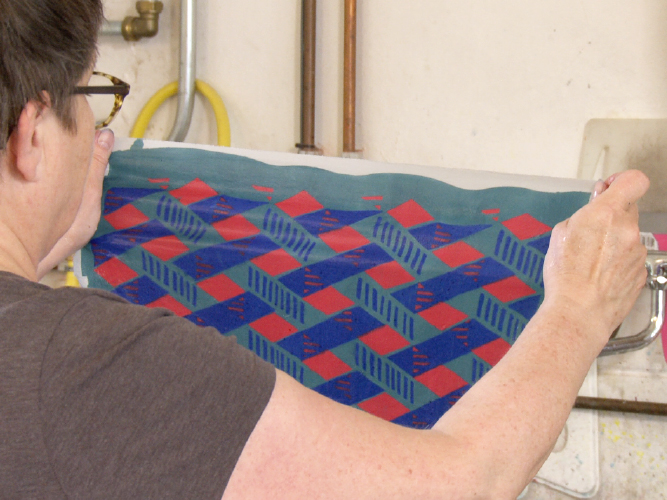
Katazome: Japanese Stencil Dyeing and Textile Art
Katazome (型染め) is a traditional Japanese dyeing technique in which patterns are applied to fabric using hand-cut stencils and a resist paste. The paste prevents the dye from penetrating selected areas of the textile. Once the fabric has been dyed and the paste removed, the characteristic pattern is revealed. Combining design, craftsmanship and colour, Katazome has been used for centuries to decorate kimono and other forms of Japanese textile.
Artist Christine van der Heide specialises in this distinctive technique. She studied Katazome with Japanese master Akemi Nakano Cohn and uses the traditional method as a foundation for her own designs and artistic language.
What is Katazome?
The Japanese word katazome can loosely be translated as ‘stencil dyeing’. Kata (型) refers to a form, pattern or stencil, while zome or some (染め) refers to dyeing.
Unlike conventional printing techniques, the design is not simply printed onto the surface of the fabric. In traditional Katazome, a stencil is placed on the textile and a resist paste is applied through its open areas. Traditionally made from rice-based ingredients, this paste temporarily protects selected areas of the fabric.
When the textile is subsequently dyed, the colour cannot penetrate the fibres covered by the resist. Only after the paste is removed does the complete pattern become visible. The protected areas contrast with the dyed fabric to create the final design.
The Kyoto National Museum distinguishes several approaches within the wider Japanese tradition of stencil dyeing. A stencil can be used to apply colour directly, but it can also be used to apply wax or rice paste that prevents dye from reaching selected areas of the fabric.
How does the Katazome technique work?
Katazome is an artisanal process consisting of several carefully executed stages. The design, stencil, resist paste, fabric and dye all influence the final result.
1. Creating the design
Every Katazome work begins with a design. The composition must not only work visually, but also function as a stencil. Positive and negative space are therefore fundamental to the process: which areas will eventually take on colour, and which will remain protected?
2. Making the stencil
The design is translated into a stencil. Traditionally, intricate patterns are cut by hand from specially prepared paper.
Historical examples show just how refined these stencils can be. Nineteenth-century Japanese stencils preserved in museum collections feature remarkably detailed representations of landscapes, plants, geometric forms and other motifs. Some delicate stencils were reinforced with silk to give them additional strength.
3. Applying the resist paste
The stencil is positioned on the fabric and a resist paste is applied through its open sections. Traditionally, this paste is made using rice-based ingredients.
The paste adheres to the textile and forms a temporary barrier between the fibres and the dye.
4. Repeating the pattern
One of the defining characteristics of Katazome is the possibility of using the same stencil repeatedly.
After the paste has been applied to one section, the stencil can be moved and carefully aligned with the previous impression. In this way, a relatively small stencil can generate a continuous pattern across a much larger piece of fabric.
This principle of repetition is essential to many traditional Japanese textile designs.
5. Dyeing the fabric
Once the resist paste has been applied, the fabric is dyed. Depending on the desired result, colour can be introduced in different ways, including brushing and immersion dyeing.
Indigo is strongly associated with historical Japanese resist-dyeing traditions and appears frequently in surviving examples of Katazome textiles.
The areas protected by the resist paste absorb little or no dye, while the exposed fibres take on the colour.
6. Removing the resist
After dyeing, the resist paste is removed.
Only at this stage is the complete pattern revealed. Dyed and undyed areas come together to form the final composition.
This indirect way of creating an image is one of the fascinating aspects of Katazome. The artist creates the design not only by deciding where colour should appear, but equally by determining where colour should be prevented from appearing.
The history and origins of Katazome
Katazome belongs to Japan’s long tradition of textile dyeing and pattern design. The use of stencils made it possible to reproduce designs accurately and apply repeating patterns efficiently across larger areas of fabric.
The technique offered a practical alternative to expensive and labour-intensive patterned woven textiles. Over time, however, Katazome developed far beyond its practical origins and became a sophisticated craft and art form with its own visual language.
The long history of the technique is reflected in museum collections around the world. The Metropolitan Museum of Art in New York, for example, holds a Japanese Katazome mihonchō, or sample book of Katazome designs, dating from around 1680.
Numerous examples from the nineteenth century have also survived. The Los Angeles County Museum of Art holds an early nineteenth-century cotton summer kimono, or yukata, decorated using a stencil paste-resist dyeing technique.
Katazome was not restricted to luxurious garments. Stencil-dyed textiles were used in many different contexts and by different groups within Japanese society, from formal and ceremonial clothing to workwear and festival garments.
Katazome, pattern and repetition
Repetition plays an important role in Katazome.
A single stencil can function as the building block for a much larger composition. This creates a fascinating relationship between regularity and the handmade.
Repetition gives a pattern rhythm and structure. Yet every piece remains the result of a manual process. Positioning the stencil, applying the resist and dyeing the textile all require precision and craftsmanship.
In particularly accomplished examples, separate sections of fabric can even be joined in such a way that the pattern appears to continue seamlessly from one panel to another.
The technique can therefore be used both for individual motifs and for elaborate designs extending across large surfaces of textile.
Which materials are used for Katazome?
Katazome is primarily associated with textiles. Historical examples can be found on materials including cotton and silk, as well as textiles made from other natural fibres.
The properties of the material have a direct influence on the final result. Dye can penetrate thin fabrics differently from heavier or more densely woven textiles. The structure of the fibres also affects how the resist paste adheres and how the colour is absorbed.
Katazome is therefore not simply a technique of drawing and dyeing. An understanding of fabric, fibres, dyes and the behaviour of materials is an essential part of the craft.
From functional object to art
One of the qualities of Katazome is that the boundary between applied and autonomous art does not need to be clearly defined.
A pattern can exist as an independent visual composition while simultaneously becoming part of a garment or textile object.
Historically, Katazome has been used for kimono, yukata, ceremonial clothing, workwear and many other textile applications. Today, the technique also has a place within contemporary textile and fibre art.
This raises a question that is also central to the work of Christine van der Heide: when does a textile become a functional object, and when does it become a work of art?
The two do not have to be mutually exclusive.
A work of art can be worn, just as a wearable object can be a unique work of art.
Katazome in the work of Christine van der Heide
For Christine van der Heide, Katazome connects naturally with an artistic practice in which pattern, colour, textiles and craftsmanship have played an important role for decades.
Her fascination with pattern began at art school, where she chose to study Design in 1975 and became captivated by textile and surface patterns. After graduating, she founded screen-printing studio Studio BonBon together with Alke de Kroes. From 1979 until 1988, they designed and printed their own patterns.
Over the years, Christine continued to explore a wide range of techniques and materials, including screen printing, weaving, felting, plant-dyed yarns, silk, paper and linen.
Her encounter with Katazome deepened this long-standing interest in the relationship between pattern, textile and colour.
Christine studied the technique with Japanese master Akemi Nakano Cohn and subsequently developed her own approach to the traditional process.
Rather than simply reproducing historical Japanese patterns, she uses the traditional technique as the technical foundation for her own visual language. Her experience with pattern and her distinctive use of colour meet the precision, repetition and layering inherent in the Japanese craft.
The result is work rooted in a centuries-old tradition while remaining unmistakably her own.
What makes Katazome special?
Katazome brings together qualities that may initially appear to be opposites.
The stencil creates repetition and structure, yet the process remains handmade. The technique demands precision, while the behaviour of fabric, paste and dye always introduces an element that cannot be completely controlled.
A pattern may be carefully planned in advance, but it only reaches its final form through the process of dyeing.
The relationship between positive and negative space is equally important. The artist does not simply design what will become visible. The areas that remain undyed are just as important to the composition as the areas that receive colour.
Katazome is therefore more than a method for transferring a pattern onto fabric. It is a way of designing in which form, rhythm, repetition, material and colour are interconnected from the very beginning.
Frequently asked questions about Katazome
What does Katazome mean?
Katazome (型染め) is a Japanese technique for dyeing and decorating textiles using stencils. In traditional forms of Katazome, a stencil is used to apply a resist paste that determines which areas of the fabric will and will not absorb dye.
Where does Katazome come from?
Katazome originates in Japan and belongs to the country’s long tradition of textile dyeing and pattern making. Historical examples and design books survive from Japan’s Edo period.
Is Katazome the same as screen printing?
No. Although both techniques can be used to create repeating patterns, the processes are different.
In screen printing, ink or dye is transferred directly through a screen onto the material. In traditional Katazome, a stencil can be used to apply a resist paste that prevents dye from penetrating selected areas of the textile during a later dyeing stage.
What is Katazome used for?
Katazome is primarily associated with textiles. Historically, it has been used for kimono, yukata, ceremonial garments, workwear and other fabrics. Today, the technique is also used by textile and fibre artists as an artistic medium.
What dyes are used in Katazome?
Different dyes and pigments can be used depending on the fabric, period and desired effect. Indigo has an important place in the Japanese tradition of resist-dyed textiles and can be found in many historical examples of Katazome.
What makes Katazome recognisable?
Characteristic elements include the use of stencils, the interaction between dyed and resisted areas, and the repetition of patterns. Because the individual stages are performed by hand, Katazome combines the structure of a repeating design with the subtle variations of an artisanal process.